
Explore Our Energy and Infrastructure Expertise
Why infrastructure counts: Turning Africa’s infrastructure gap into investable growth
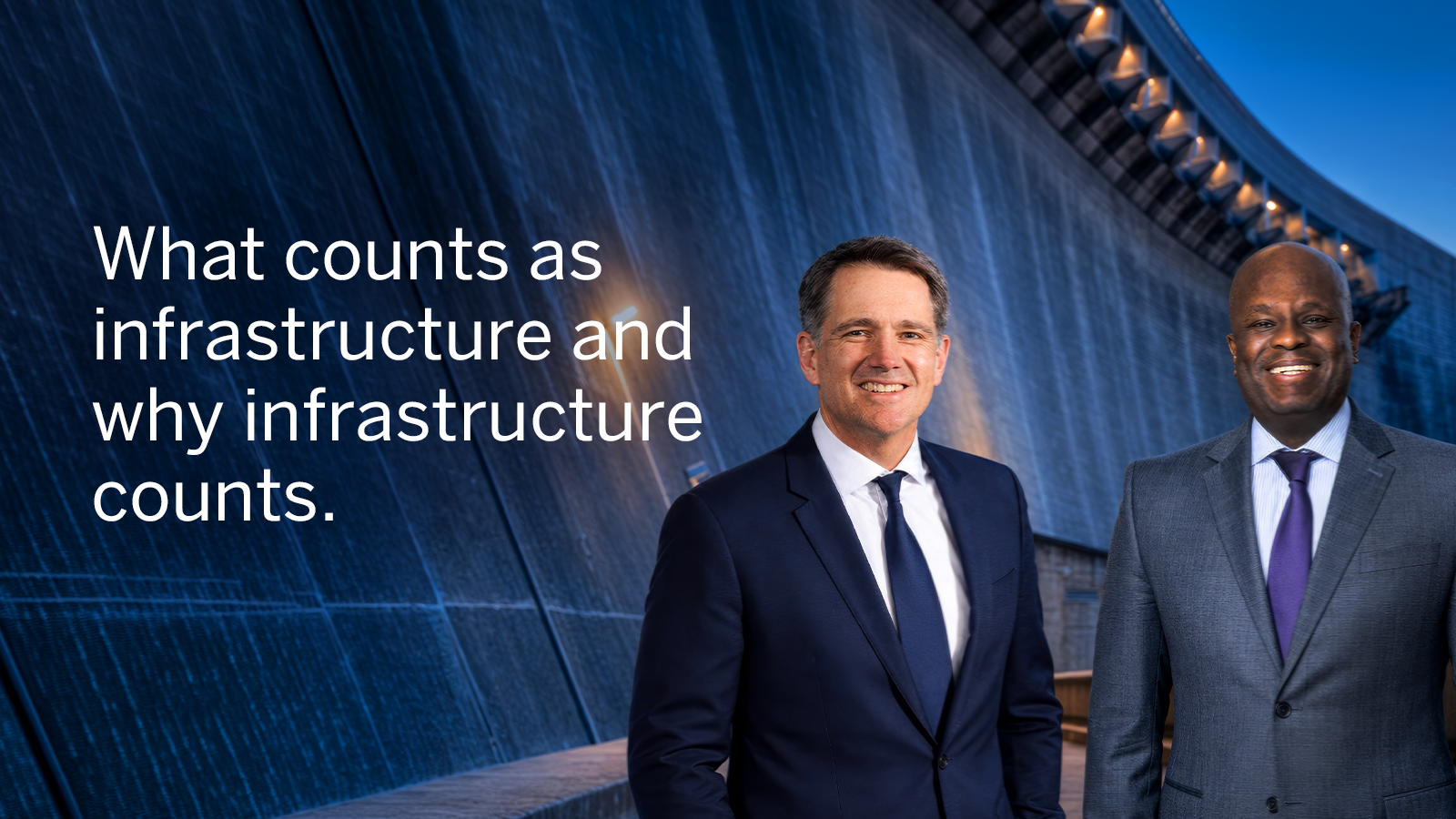
Infrastructure in Africa is often associated with roads, ports, rail, power grids and water systems. The Standard Bank podcast discussion with Stephen Barnes, Head of Corporate and Investment Banking South Africa at Standard Bank, and Mohale Rakgate, Acting Head, Infrastructure Finance and Implementation Support Agency, frames infrastructure more broadly: the systems that enable economies and societies to function.
Initially recorded last year to mark the Business 20 hosted in South Africa, the conversation continues to offer strategic insights on infrastructure and growth in Africa.
Stephen Barnes describes infrastructure as the productive assets that support economic activity, including energy, roads, rail, transport, water and digital networks. But he also points to the people, governance structures and social systems that support the functioning of an economy. Mohale Rakgate reinforces this wider definition, distinguishing between economic infrastructure, such as rail, roads, ports, water, Information and Communications Technology (ICT) and energy, and social infrastructure, including education, housing and health.
The multiplier effect of productive infrastructure
The reason infrastructure counts is not only because of the asset being built, but because of what it enables. Barnes notes that each rand spent on productive infrastructure typically creates one-and-a-half to three rand’s worth of benefit in the broader economy. This multiplier effect links infrastructure investment directly to wider economic activity.
Digital infrastructure provides a practical example. When fibre or tower networks are rolled out into rural areas, communities gain more than connectivity. Small and medium-sized enterprises can market their businesses online, access payment systems, obtain business data and use learning materials. Infrastructure therefore becomes a platform for Small and medium-sized enterprises (SME) participation, productivity and economic opportunity.
From need to bankable investment
The discussion makes clear that Africa’s infrastructure challenge is not only about the availability of capital. Rakgate argues that there are “pools and pools of capital” looking for investment opportunities. The critical task is preparing and de-risking projects so that private-sector finance can participate.
The Olifants Management Model Programme illustrates this model. The R8.5 billion water project in Limpopo is intended to support platinum mines while also enabling surrounding communities to access water. Rakgate explains that approximately R3 billion in government funding was required to support community access, while the rest is being raised from other partners and the private sector, including Standard Bank.
This reflects the complementary role of development finance institutions and commercial banks. Development Finance Institutions (DFIs) can support project preparation and risk mitigation, while commercial banks can finance projects with sustainable cash flows.
Governance, integration and long-term growth
Governance is positioned as central to sustainable infrastructure investment. Barnes states that Standard Bank’s research identifies governance and transparency as the number one determinant of long-term economic prosperity. Rakgate adds that strong governance frameworks, transparent procurement and sustainable maintenance are essential to preventing projects from becoming “white elephants”.
Looking ahead, both speakers identify regional integration as a major opportunity. Barnes points to the African Continental Free Trade Area (AfCFTA), noting the growing adoption of the agreement across the continent and its potential to significantly boost Africa’s economic integration, trade, and collective growth in the years ahead. He also highlights regional power generation, rail and transport systems as areas where integration can improve efficiency.
Infrastructure counts because it connects capital, governance, economic activity and social impact. Early-stage project preparation, including the necessary feasibility, planning and stakeholder alignment is essential to help turn Africa’s infrastructure needs into investable growth.
Frequently Asked Questions
Why does infrastructure investment matter for Africa’s economy?
Infrastructure investment supports broader economic activity beyond the asset itself. Stephen Barnes notes that each rand spent on productive infrastructure can generate one-and-a-half to three rand’s worth of benefit in the broader economy.
Which areas of infrastructure are a priority for Standard Bank?
The discussion identified transport, water, energy and digital infrastructure as areas of commercial focus for Standard Bank, while also recognising social infrastructure such as education, housing and health as important areas often supported by development finance institutions and government.
What makes an infrastructure project bankable?
According to the discussion, commercial banks typically finance projects that produce cash flows they can lend against. Project preparation and de-risking help make infrastructure projects more suitable for private-sector participation.
What does the Olifants River Water Resources Development Project demonstrate?
The project demonstrates how government funding and private-sector capital can work together. The R8.5 billion water project includes approximately R3 billion in government funding for community water access and around R5 billion being raised from the private sector.
Why is governance important for infrastructure investors?
Governance supports transparency, sustainable delivery and long-term economic prosperity. Barnes states that governance and transparency are the number one determinant of long-term economic prosperity, while Rakgate highlights the importance of procurement, maintenance and strong governance protocols.

Explore more insights



Sectors
31 Jul 2026
Long Walk to Power Resilience – Unlocking LNG into South Africa
Gas means different things in different geographies. In the United States of America (USA), “Gas” means natural gas or gasoline. In South Africa (SA), gas normally means Liquefied Petroleum Gas or more commonly, cylinders seen at restaurants.
Trade
10 Feb 2026
Standard Bank driving Africa's trade future at GTR Africa 2026
We will once again play a leading role at the 20th annual Global Trade Review (GTR) Africa 2026 conference, set to take place in Cape Town on 12 to 13 March 2026. The event brings together senior decision-makers, policymakers and trade finance practitioners with over 70 expert speakers and industry leaders.