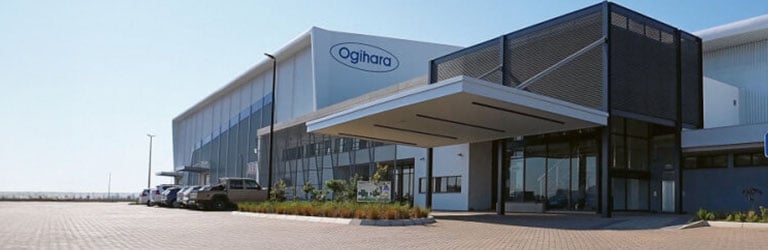
Localisation: Ogihara plant opens in Durban
Standard Bank supports automotive localisation in South Africa by backing Toyota Tsusho R1.1bn Dube TradePort manufacturing facility, strengthening the automotive supply chain in Africa.
As South Africa’s automotive industry grapples with rising global tariffs, intense competition from Asian automakers, and a fragile local economy, Toyota Tsusho in South Africa, a subsidiary of CFAO South Africa, has chosen a different path: to increase its investment rather than withdraw.
The plan came to fruition with a complex, multi-year investment that facilitated R400 million in structured funding put together by Standard Bank Corporate and Investment Banking (CIB). This supported the establishment of a R1.1 billion stamp press Dube TradePort manufacturing plant in KwaZulu-Natal (KZN). This greenfield project by the Japanese trading giant, in partnership with Thailand’s Ogihara, is one of the largest automotive localisation efforts in the province, demonstrating strong confidence in the region despite recent challenges.
Investing when others retreat
The timing of the investment is noteworthy. As automotive companies reduce their presence in South Africa, such as Goodyear’s decision to shut down its Eastern Cape tyre plant, Toyota Tsusho has opted to expand its manufacturing operations in the country.
“We have always been committed to the country’s automotive master plan and increasing local content in South Africa-made vehicles,” says Shaun Govender, Chief Financial Officer of Toyota Tsusho Africa. “We’ve had our fair share of challenges over the years, from global issues like COVID and the 2022 floods in KZN, which we successfully navigated. We take confidence from this, but it also speaks of the resilience and quality of the local automotive manufacturing ecosystem.”
For Toyota Tsusho, one of Japan’s top seven trading houses with global expertise in supply chain management and manufacturing support, this investment is a strategic development. Govender states, “Our primary goal is to expand our presence. We see greater localisation as a means to strengthen our existing supply chain and enhance our capabilities in South Africa.”
The economic ripple effect
The plant will initially create 215 direct jobs and is estimated to add another 1 000 through the sector’s multiplier effect. But Toyota Tsusho’s vision extends beyond job creation. Thirty engineers from Thailand and Japan are on site to upskill the local team. “An important aspect of localisation projects is the skills transfer,” Govender says. “We’ve been fortunate in that we have a strong partner on this project, Ogihara Thailand. Their technical know-how was crucial during the setup and start phases.”
The skills transfer builds lasting industrial capability. “It not only boosts productivity and quality but also reduces long-term reliance on foreign expertise,” Govender notes. “It strengthens South Africa’s industrial base, enhances global competitiveness, and contributes to broadening economic growth through job creation, innovation, and the empowerment of local communities.”
Integrating supply chains
The 35 000 m2 facility will produce small and medium-sized, pressed steel inner body parts and other structural elements for Toyota Hilux and Fortuner models. During the initial phase, the plant will manufacture 101 different parts and has potential to increase this number at a later stage. All these parts were previously imported from Thailand.
“South Africa's automotive industry has a deep base of original equipment manufacturers, Tier 1 and Tier 2 component suppliers, and skilled labour that deliver to global quality standards,” explains Sadeshan Moodley, Executive Vice-President of Client Coverage at Standard Bank CIB. “Localising and deepening production in South Africa offers global players greater cost efficiency and resilience, and reduces their over-reliance on a single geography.”
Standard Bank CIB’s long-standing relationship with Toyota Tsusho was decisive for the manufacturer, and the bank became involved more than two years ago when the project was still in concept stage.
“We view Standard Bank as a strategic partner on this localisation project,” Govender confirms. “Through their deep understanding of our business and automotive supply chains, they were able to assess the project from an ecosystem-wide perspective. This was instrumental in shaping a funding structure that supports our long-term industrial development and localisation objectives.”
Says Moodley, “We recognise that component manufacturers like Ogihara are the cornerstone of the automotive sector, driving industrial beneficiation, and sustaining thousands of skilled jobs in the economy.”